


What Is Salesforce Data 360? Answers & Tips From Experts

As a nonprofit or association leader, you know how integral data is to connecting with members and donors, maximizing efficiency, driving revenue, and leveraging AI. But your database is only as valuable as your ability to put it to use.
An IBM study of Salesforce customers identified a standout group called “Data Pioneers,” organizations that leverage Salesforce AI capabilities to build high-quality data, strong governance, and seamless connectivity. The results speak for themselves: Data Pioneers significantly outperformed peers in data visibility, operational efficiency, revenue growth, and profitability. Salesforce Data 360 is built to help your organization get there.
This guide covers the essentials of Salesforce Data 360 and helps you identify whether your organization is ready to make the most of it.
What is Salesforce Data 360?
Salesforce Data 360, formerly known as Data Cloud, is a tool built on Salesforce that pulls together information from the systems your organization already uses, such as your CRM, email platform, event software, and more, into an accurate, unified picture of every supporter.
Used with other Salesforce solutions, Data 360 gives your organization a complete view of every donor, volunteer, and member. It surfaces deeper insights by analyzing patterns across your unified data and triggers automated actions, like follow-up emails or task assignments, based on what that data reveals, enabling you to deliver personalized communications that deepen connections and drive long-lasting support.
How Salesforce Data 360 Works
Data 360 unifies data from multiple platforms to give you a comprehensive view of your database, making it easier to extract actionable insights. Salesforce breaks the process down into five steps:
- You start with data spread across multiple systems, such as your CRM, email platform, event management tool, and prospect research data.
- Data 360 connects these sources, bringing the information together in one view.
- The solution standardizes and “harmonizes” data through data mapping and identity resolution, ensuring that a donor or member is recognized as the same person across all systems.
- Your data becomes a single, trusted source of truth.
- Your organization activates that data to surface new insights, build automated workflows, power AI tools, and deliver more personalized supporter experiences.
Data 360 is designed to handle very large amounts of data without creating extra work for your team. In practice, that means it can connect directly to external data sources, like prospect research platforms and data warehouses, without duplicating records, keeping your data clean, consistent, and easy to manage.
Salesforce Data 360 Features
The platform includes a number of capabilities that help you bring your data together and put it to work. Here are the ones most relevant to nonprofits and associations:
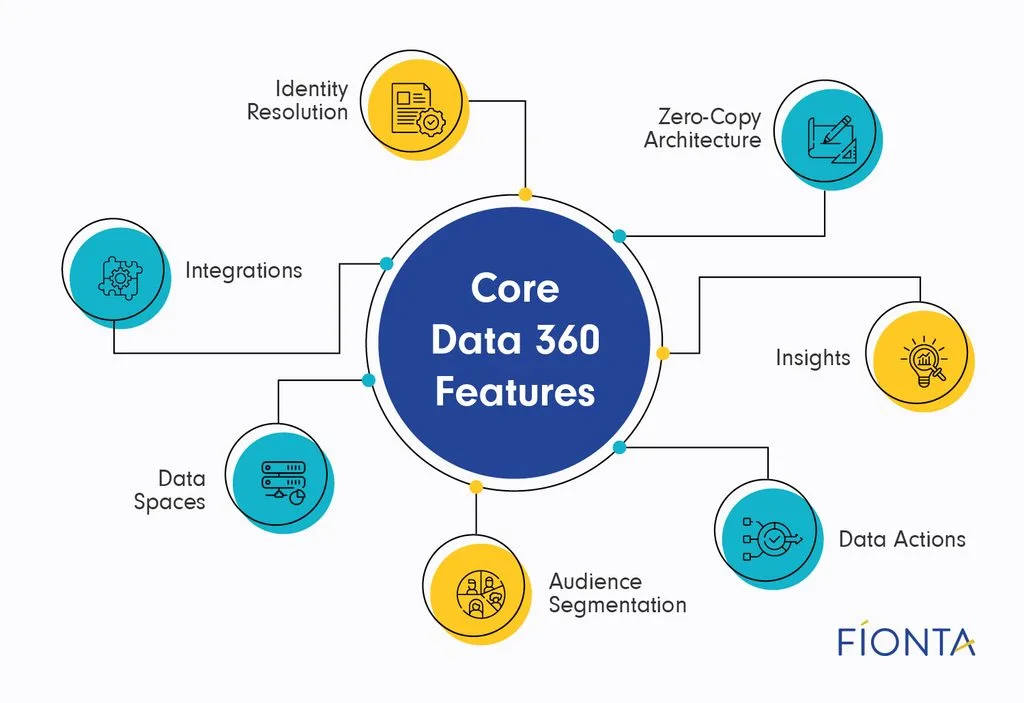
- Identity resolution: Data 360 can identify duplicate records for the same person or organization and automatically merge them into a single profile. This way, you won’t have one profile for “J. Smith,” the volunteer, and a second for “John Smith,” the donor.
- Zero-copy architecture: View and use data from external sources, like prospect research platforms or data warehouses, without copying and storing it in Salesforce, keeping your data clean and reducing duplication.
- Insights: Data 360 supports calculated, streaming, and real-time insights so your team always has an accurate, up-to-date picture of your members, donors, and constituents.
- Data actions: Monitor changes in your data and automatically trigger workflows based on what you find. For example, if a donor reaches the mid-level giving threshold, a task to send a handwritten thank-you note is automatically assigned to a staff member.
- Audience segmentation: Create segments your team can use to better understand and communicate with donors or members, whether that’s lapsed volunteers, first-time donors, or members approaching renewal.
- Data spaces: Keep your data organized by creating separate, clearly defined sections within your database. For example, a multi-chapter association might create a dedicated space for each chapter.
- Integrations: Data 360 includes built-in connectors for many popular tools, and a Salesforce partner can connect the rest, including older systems that don’t integrate easily. It also works with reporting tools like Tableau to turn raw data into clear, actionable reports.
Should You Use Salesforce Data 360?
Now that you have a solid understanding of what Data 360 is and how it works, it’s worth reflecting on whether it’s the right fit for your organization. Start by asking a few questions about your current data management and activation processes:
- Is Salesforce our primary system of record for donor or member data?
- Is our data unified, or do we have to manually consolidate information from multiple sources?
- Do we have the capacity to unify our data, or would it be too costly and time-consuming with our current technology?
- Can we send personalized communications based on information like website activity or event attendance, even if that data isn’t stored directly in Salesforce?
- Do we have duplicate records that we can’t automatically merge?
- Is our data clean and unified enough to start leveraging AI tools like Agentforce?
If you’re still unsure, reach out to the Fíonta team. We’re happy to discuss your current situation and identify potential opportunities and ROI you could gain from leveraging Data 360.
Additionally, you can look for the following signs that your organization could benefit from Data 360:
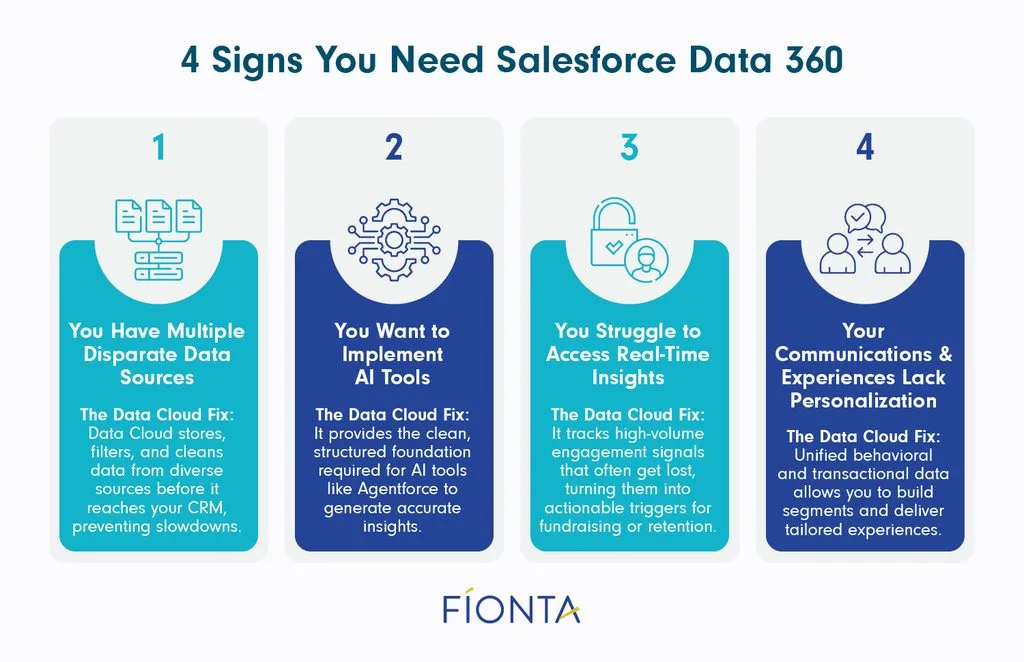
You Have Multiple Disparate Data Sources
If you’re like most nonprofits and associations, your data lives in more than one place. From your CRM and email platform to your LMS, event management tool, and prospect research data, managing multiple sources is simply the reality of running a modern organization. On its own, that isn’t a problem. In fact, having granular data from multiple sources can provide deeper insights into specific parts of your operations. Problems arise when those sources are disconnected, tied together only by standard integrations, or involve large, complex datasets.
Historically, connecting scattered data sources meant building and maintaining custom integrations between every tool your team uses. Instead, Data 360 reduces that burden by pulling data directly from outside sources and putting it to work without routing everything through your CRM first. The result is less complexity, fewer duplicate records, and a truly complete view of your supporters or members.
You Want to Implement AI Tools
Nonprofit and association teams are increasingly turning to AI to do more with less. Whether that’s personalizing donor and member communications at scale, automating manual tasks to free up staff time, or predicting which donors are likely to give and which members are at risk of lapsing, AI has real, practical applications for your organization. But none of it works without the right data foundation.
AI outputs are only as good as their inputs. If your AI tools are working from incomplete or inaccurate records, they will produce flawed results. To get the most out of AI, your data needs to meet four standards:
- Unified: AI needs a single source of truth, free of duplicate profiles, to avoid confusion from conflicting information.
- Harmonized: Data fields should be standardized so AI tools don’t misread numbers or details, like inconsistent date formats.
- Clean: Because AI treats the information you provide as absolute truth, your data should be free of inaccurate or outdated records.
- Understandable to AI (or vectorized): Unstructured data, such as staff case notes, needs to be organized in a way that AI can derive context and meaning from, not just match keywords.
If your current system doesn’t meet these standards, you may struggle to take full advantage of AI tools.
The Data 360 Fix: Data 360 brings your structured and unstructured data together in a consistent format. Paired with a cleanup and governance plan from a Salesforce expert, it helps AI tools work from accurate, complete information, produce fewer errors, and offer more useful, real-time insights. Think of Data 360 as an essential prerequisite for tools like Agentforce.
You Struggle to Access Real-Time Insights
If your data is scattered across systems, actionable insights can slip through the cracks. For nonprofits and associations, this often means missing signals that could meaningfully deepen engagement or drive revenue. For example:
- Event no-shows: You don’t launch a “We Missed You” campaign because attendance data is siloed in your event management software.
- Portal logins: You miss that a member at risk of lapsing logged in for the first time in months, a critical sign of reengagement.
- LMS completions: You never follow up or congratulate a member for completing a course.
- Webinar engagement: You don’t realize a particular topic or format drove high watch times, signaling strong audience interest.
The Data 360 Fix: Data 360 captures data that would otherwise stay locked in outside tools and puts it to work in real time. For instance, you can trigger a donation ask the moment a donor visits your “Impact” page for the third time.
Your Communications & Experiences Lack Personalization
Messy, fragmented data makes it difficult to segment and target your audience based on their interests and behaviors. This leads many organizations to default to generic, mass emails that leave supporters and members feeling like just a number. It can even result in mistakes, like asking long-time members to join an onboarding meeting or sending “We Miss You” emails to highly engaged members.
The Data 360 Fix: Data 360 unifies behavioral data (how supporters engage with you) and transactional data (what they donate or pay for) in real time. The platform also supports segmentation to help you target the right audience. This way, you can deliver the tailored experiences your supporters or members expect, from personalized recommendations to local event invitations.
Wrapping Up
If your organization is looking to build a forward-thinking foundation for real-time insights and AI-driven experiences, implementing Data 360 is a strong place to start. You’ll unlock the full benefits of your data and stop missing out on valuable opportunities. To learn more about how to get the most out of your investment in Salesforce and Data 360, reach out to Fíonta’s team of experts.
Explore these additional resources on Salesforce and optimizing your digital presence:
- How to Use Nonprofit Cloud for Fundraising Success. Learn how Salesforce can help manage your nonprofit’s operations and enhance your fundraising campaigns.
- Your Handbook to Salesforce Implementation for Nonprofits. Haven’t made the move to Salesforce yet? Discover what implementation looks like when you work with a team of experts.
- Designing for Donor Engagement: UX Tips for Nonprofits. Effective data management is just one piece of the donor engagement puzzle. Explore the importance of UX for nonprofits.
Managing and making sense of complex data can be daunting. Fíonta has the experience and technical skills you need to unify and activate supporter data. Contact us to learn more.