


The Salesforce CRM is one of the top customer relationship management (CRM) platforms in the world—and for good reason. Because of its flexibility, the platform supports thousands of organizations across industries, from large corporations to nonprofits and associations. Its core capabilities give mission-driven organizations the flexibility needed to manage operations, optimize efficiency, and engage with their communities.
But another key benefit of using Salesforce is that users gain access to other tools in the Salesforce ecosystem. With Salesforce Experience Cloud, organizations can design and manage a variety of branded, online experiences for supporters, staff, and partners.
To help your organization better understand what Experience Cloud is and what it can do for your nonprofit or association, this guide covers common questions, uses, and steps to get started.
Salesforce Experience Cloud FAQ
What Is Salesforce Experience Cloud?
Built on top of the Salesforce CRM, Experience Cloud is a set of functionalities that allows organizations to create online experiences, such as member portals or help desks, that are closely connected to their CRM. This ensures data flows seamlessly from the website to their CRM, enabling nonprofits and associations to keep all core information in one centralized system.
How Does Salesforce Experience Cloud Help Mission-Driven Organizations?
Experience Cloud is designed to provide smoother, more seamless experiences to your supporters, members, or beneficiaries, helping your organization overcome common pain points like:
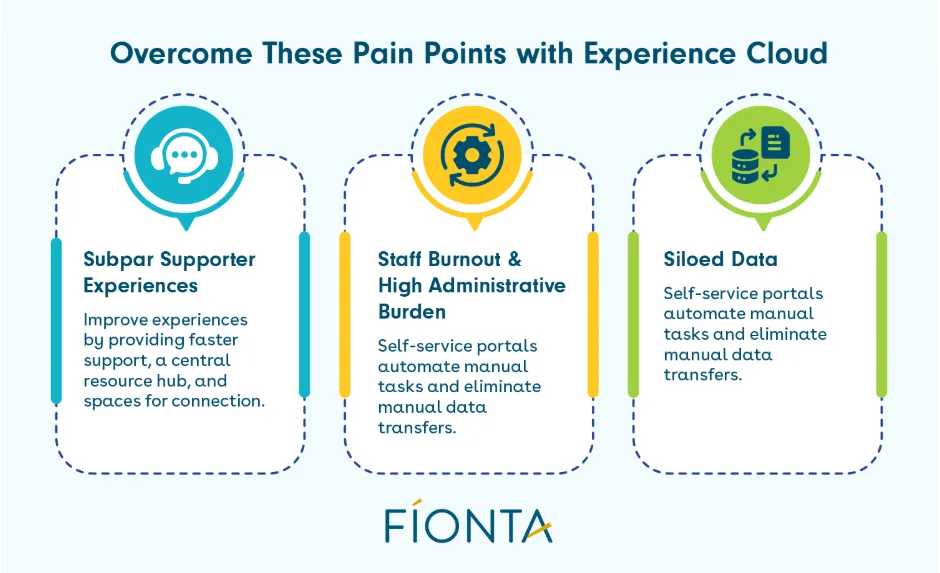
- Subpar supporter experiences. If your team is overwhelmed, it can be challenging to provide excellent experiences to your community. Custom online experiences can bridge this gap by providing faster support for common questions, spaces for connection and collaboration with other community members, a central hub for resources, and more.
- Staff burnout and high administrative burden. Reduce the number of questions or manual tasks staff must address with a self-service portal. For example, you can allow association members to independently pay dues, register for events, and manage continuing education logistics from a self-service portal. Because these experiences are linked to your CRM, staff also won’t have to manually transfer data.
- Siloed data. Leveraging a third-party portal may not integrate gracefully with the rest of your tech stack. For Salesforce users, Experience Cloud is the best tool for creating these tailored experiences while maintaining a comprehensive database.
Why Does Experience Cloud Stand Out?
Experience Cloud offers easy-to-use features your team can leverage to facilitate customizable experiences. These include:
- Flexible data integration. Like the rest of Salesforce’s tools, Experience Cloud is highly flexible and can integrate with many other platforms and applications. Keep your data organized by integrating it with information from Salesforce or third-party systems to manage any record or object.
- Accessible templates. Experience Cloud includes several templates for creating and designing webpages. For example, you might use Experience Cloud to build a volunteer hub that allows supporters to browse upcoming shifts, log hours, and update contact information. Use drag-and-drop design tools to create a login page, an account management page, or a members-only forum. We’ll dig into more details about these templates later in the guide.
- Top security measures. Nonprofits and associations may hesitate to create external-facing experiences that are so closely connected to their CRMs due to security concerns. However, Experience Cloud is fully equipped to provide limited and controlled access to your CRM at your discretion. Manage granular data access controls and adjust permission levels to keep sensitive information private.
Would Experience Cloud Replace Our Existing Website?
No, Experience Cloud typically does not replace an organization’s main, public-facing website. These channels each have important yet distinct purposes:
- Your main website is for public-facing marketing, building your reputation, telling your story, and sharing your case for support with potential supporters. It’s where future members of your community go to learn more about your cause before deciding to get involved.
- Experience Cloud helps you create a secure, authenticated website where staff, supporters, and members can access exclusive resources and communities that are not open to the public. Or, create a public resource, like a knowledge hub, that is connected directly to your CRM and other Salesforce tools (like Agentforce).
While these spaces serve different purposes, they should be clearly connected. Add a “login” button to your primary website that takes users to your gated community, and link to public knowledge bases or help centers in the main navigation menu.
Can We Make The Transition From Our Main Website Feel Seamless?
Yes. The Experience Builder allows you to customize the look of your sites. You can customize pre-built themes or create your own custom theme to align with your main website. Configure various elements of the website and use your organization’s exact brand colors, fonts, and imagery for a seamless transition between sites.
When your main website and the custom experience have the same polished feel, supporters won’t feel like they’ve left your main site when they log into a portal. A seamless experience can also strengthen trust in your organization, which is crucial for nonprofits and associations.
Can We Use AI Agents (Agentforce) Within Our Member Portal?
Yes, you can deploy AI agents on any online experience built with Experience Cloud. While this process does not require a developer, you may need help from a Salesforce administrator.
Agentforce agents can then address users’ requests and questions immediately, enhancing their experience with your organization and freeing up staff time. For example, an association member might request specific resources from your library or ask for instructions on how to update their profile. Or, a beneficiary could find out what documents they need to submit during the intake process.
Experience Cloud Use Cases
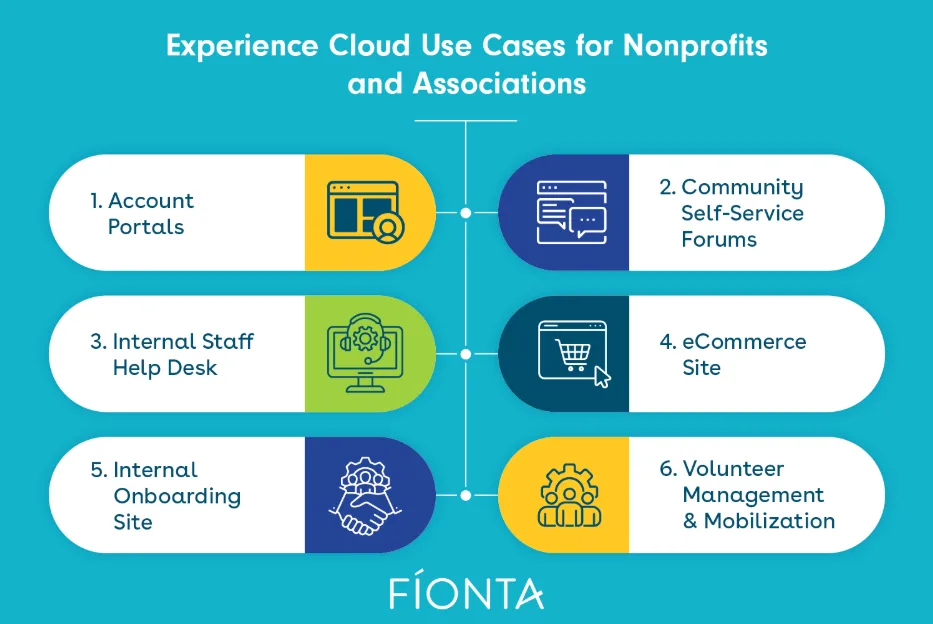
Account Portals
Associations and nonprofits with membership programs can use Experience Cloud to build member account portals. From there, members can interact with your Experience Cloud site to manage their account information, adjust their giving levels, and perform any other activities you want to provide them access to.
Shifting these administrative tasks over to a self-service model reduces your team’s workload, allowing staff to focus more on building relationships and creative or strategic work.
Community Self-Service Forums
Experience Cloud was formerly known as Community Cloud, and it can still support community interactions through forums that let users talk to one another, answer questions, and complete various self-service tasks. For example, a discussion forum can allow association members to ask each other questions, share advice, and weigh in on industry trends.
For associations, these online experiences can make you more “sticky” by giving members an easy way to engage with each other, not just your organization.
Internal Staff Help Desk
Experience Cloud also allows you to build sites for internal use. For instance, an enterprise-sized organization might use Experience Cloud to set up a help desk staff can use to ask questions about technical issues or send tickets to the technology department. Instead of creating a simple FAQ list, use Experience Cloud to host a knowledge base that is connected to your CRM and other Salesforce tools.
Integrating AI-powered tools like Agentforce can speed up response times and even automatically refer staff to resources that help them solve problems independently. Then, any complex issues can be escalated to your IT team.
eCommerce Site
When used with Agentforce Commerce (formerly Commerce Cloud), you can leverage the Experience Builder to create a branded online storefront. Use this site to monetize resources, such as exclusive research reports or continuing education courses, or simplify transactions like membership dues.
Using Experience Cloud to build your storefront, as opposed to a third-party tool, ensures purchase data from each transaction is automatically logged in the supporter or member profile in your CRM. This data can later be used to understand their preferences or behaviors, launch targeted campaigns, and engage them in future involvement opportunities.
Internal Onboarding Site
Onboarding can be a messy, complicated process if managed over email or through disjointed documents. Experience Cloud allows you to create a site that streamlines the onboarding journey for new staff, members, and even volunteers. For nonprofits, you might also create onboarding experiences for program participants if the process is long or complex.
A custom onboarding site will provide a structured path for your community, giving them a much better experience. Users will also be able to complete initial tasks more quickly, have immediate access to all relevant resources, and receive consistent training.
Volunteer Management & Mobilization
Similar to onboarding, volunteer management involves many different processes and data points. Building an intuitive volunteer journey will promote repeated engagement, helping nonprofits cultivate a loyal volunteer base. With a dedicated volunteer portal, volunteers can:
- Complete trainings
- Search for shifts
- Self-register for volunteer opportunities
- Record their hours
- Earn badges and other gamified achievements based on their contributions
As with any other Experience Cloud site, all volunteer data will be stored securely in your CRM. Volunteers will be able to view the most up-to-date information, such as that day’s schedule, without your team making manual updates.
Getting Started With Experience Cloud
If your organization already uses Salesforce, setting up Experience Cloud won’t involve any complex steps or long implementation processes. All you need to do is navigate to “Setup” and enable Digital Experiences. From here, you can start building a site.
Leveraging Experience Cloud Templates
Users can access out-of-the-box templates designed for three unique audiences: supporters, employees, and partners. Each template is highly customizable, allowing you to match it to your website’s branding.
Here’s a breakdown of what each of these templates can provide nonprofits and associations:
- Supporters: In addition to creating community and self-service tools, you can leverage Experience Cloud’s AI technology to use information stored in your CRM to engage supporters further. For example, send supporters of your membership program personalized recommendations from Experience Cloud about groups they might be interested in joining or members with similar interests that they could connect with.
- Employees: Allow remote teams to keep in touch and collaborate through internal sites. You can also integrate any third-party apps you use to manage your team’s payroll, insurance, and training courses with Experience Cloud, enabling you to create dedicated sites for each of these critical resources.
- Partners: Connect with your partners online by creating sites that allow them to access analytics, contact forms, and reports to better understand your community and how they interact with the partner’s products and services.
Experience Cloud templates are designed so that nonprofits and associations can build their pages themselves. However, your team may need assistance configuring templates and getting set up with Experience Cloud.
If your team needs help, contact our team at Fíonta to integrate third-party tools and set up your new sites.
Wrapping Up
Creating experiences with Salesforce Experience Cloud allows your organization to expand its functionalities, streamline complex processes and ongoing journeys, and cultivate communities while keeping data centralized in your CRM. Getting started is simple, but partnering with an expert can help you move beyond out-of-the-box templates and configure the site perfectly to fit within your existing technical infrastructure.
To learn more about Salesforce and engaging your community, explore these resources:
- How to Get Started and Grow with Salesforce for Nonprofits. Learn more about how to get started with NPSP or Nonprofit Cloud (now Agentforce Nonprofit), the core features the platform offers, and how to use it to grow your mission.
- Designing for Donor Engagement: UX Tips for Nonprofits. Before creating custom experiences, review these UX tips to ensure your sites are intuitive and user-friendly.
- Lead Change with Digital Accessibility for Associations. Brush up on digital accessibility rules to ensure everyone can use and engage with the sites you build with Experience Cloud.
Ready to foster a more connected community with Salesforce Experience Cloud? Contact Fíonta to begin architecting your personalized online experience.