

Transform Your Grantmaking: A Proven Roadmap to Success

As a grantmaking organization, your job is to put funds in the hands of organizations that will make the most of them. However, determining who these organizations are, how you’ll assess them, and how to distribute grant awards properly requires significant time and resources. Proper preparation and sophisticated management tools are crucial to managing your time and awarding grants as efficiently as possible.
To help your organization streamline its grantmaking process, this article will review the basics, important best practices, and the necessary technology.
Grantmaking FAQs
What Is Grantmaking?
Grantmaking is the process of awarding financial grants to nonprofit organizations, community initiatives and programs, or other charitable causes. Grant funding supplements the organization’s resources, helping them further their mission. Grants are distributed to causes that align with the foundation’s own organizational goals and values.
What Is a Grantmaker?
A grantmaker is an organization that offers grant programs to which charitable organizations can apply for funding. While many grantmaking organizations are foundations, the term also includes other organizations that award grants, such as corporations with philanthropic giving programs.
Grant recipients are the nonprofits or other causes that receive and spend the grant money. They must apply for the grants and, if awarded the funds, meet reporting requirements to communicate how funds are spent and their impact on the community.
What Are the Various Types of Grantmaking Organizations?
The three main types of grantmaking bodies include private foundations, public foundations, and corporate-owned charitable foundations. Here are the key differences between each of these organizations:
- Private foundations: Grantmaking organizations that operate independently, usually through a family or small group of individuals.
- Public foundations: Organizations established to benefit their specific communities that are broadly funded by donations from individual supporters.
- Corporate-owned charitable foundations: Corporations may run in-house giving programs, which are managed entirely by the company. Corporate foundations are separate legal entities that operate independently but are managed by a board of directors who are members of the corporation.
These organizations also have different funding sources and governance structures, which affect the application process. For example, securing a grant from a public foundation may be a longer, more competitive process than applying for a grant from a private foundation.
What Does the Grant Lifecycle Look Like?
There are many steps involved in both awarding and applying for grants. While the exact process will vary from organization to organization, it can be divided into three distinct stages:
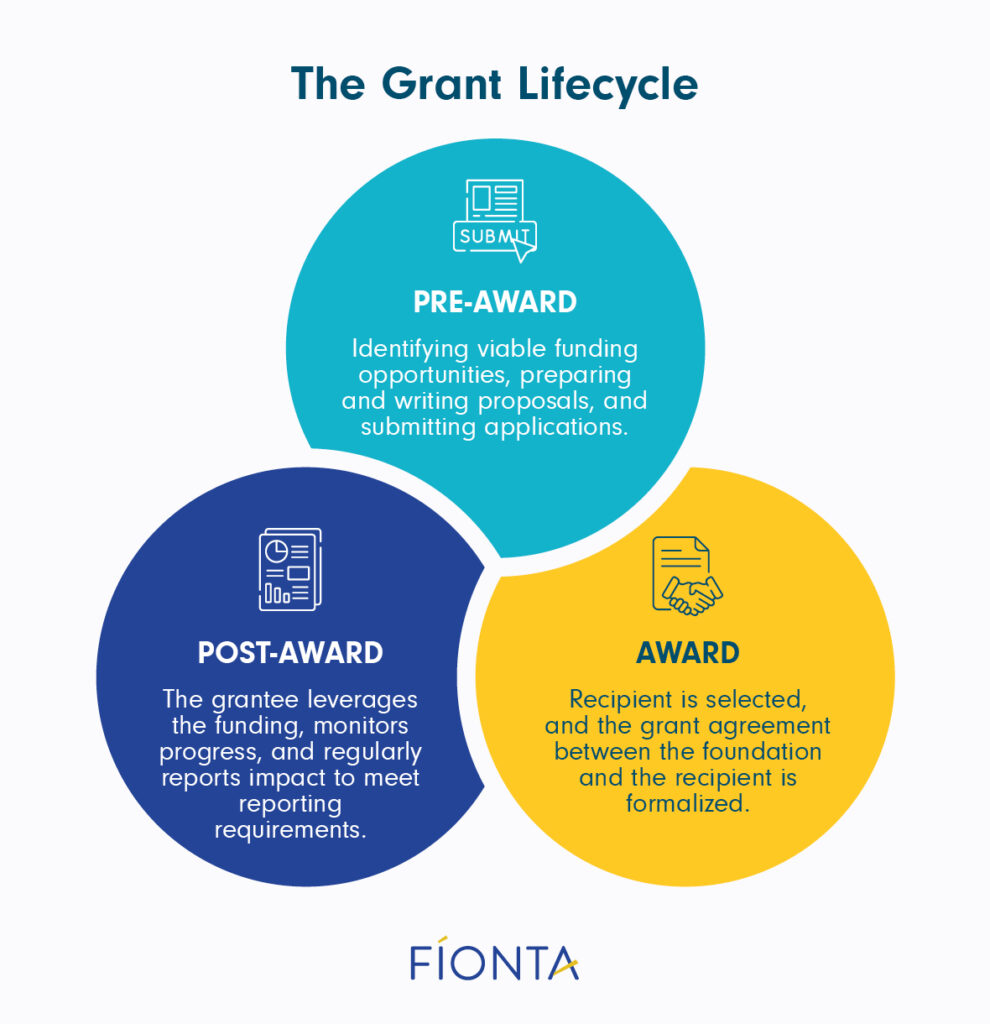
- Pre-award: This phase involves identifying viable funding opportunities, preparing and writing proposals, and submitting applications.
- Grantmakers’ responsibilities: Develop grants aligned with the organization’s vision and goals, announce the opportunities, and review applications.
- Grantseekers’ responsibilities: Identify possible funding opportunities, research requirements, and submit compelling proposals.
- Award: In this phase, a recipient is selected, and the grant agreement between the foundation and the recipient is formalized.
- Grantmakers’ responsibilities: Notify grant recipients, outline terms and expectations, finalize the agreement, and distribute the funds.
- Grantees’ responsibilities: Review and accept the agreement, prepare the tools necessary to implement the grant and track its impact, and begin using the funds.
- Post-award: After the award has been granted, the grantee leverages the funding, monitors progress, and regularly reports impact to meet reporting requirements.
- Grantmakers’ responsibilities: Oversee grant implementation, review reports, and regularly communicate with the grantee.
- Grantees’ responsibilities: Implement activities as outlined in their proposal, monitor and record progress, and create and share reports that communicate impact with the grantmaking organization.
This process is cyclical, so your organization will consistently circle back to the beginning and repeat the steps. Evaluate and adjust your process if you identify any gaps or slowdowns to streamline the process for you and your applicants.
How does Fíonta support grantmaking foundations?
Fíonta has extensive experience helping both grantmakers and grant-seekers improve their technology to better facilitate the grant process.
Here are a few examples of our work:
International Sustainable Energy Foundation (ISEF)
ISEF came to Fíonta looking for a way to simplify their platform’s processes for tracking grant applications, awards, and disbursements. The organization was already using Salesforce Grants Management, but they needed an expert partner who could customize their solution to simplify both grant management and fundraising.
Through our collaboration with the ISEF team, we developed:
- Automatic award letters that could generate accurate information about grants, budgets, and disbursements.
- Dashboards that enable ISEF’s staff to get an overview of their fundraising and grantmaking activities at a glance.
- A grantee portal that allowed ISEF to offer online application submissions, share grant statuses, submit quarterly reports, and send automatic deadline reminders to grantees.
With their new custom software solutions, ISEF was able to gain a deeper understanding of their grantees and support them during the application process.

Melanoma Research Alliance
Melanoma Research Alliance (MRA) needed to make its portfolio of available research funds more accessible on its website. Fíonta stepped in to replace their outdated grants display with a real-time Salesforce integration.
Specifically, our team:
- Built a live Salesforce connection, allowing newly awarded and updated grants to appear immediately on MRA’s website.
- Updated the existing Salesforce component to match MRA’s Webflow platform’s design system, creating a unified visual experience.
- Created front-end filtering and export options to help grant-seekers organize grants by type, year, institution, country, strategy, investigator, and keyword.
With the updated website, Fíonta enabled MRA to deliver accurate, filterable, and visually consistent grant opportunities, allowing all site visitors to easily explore MRA’s grantmaking activities.

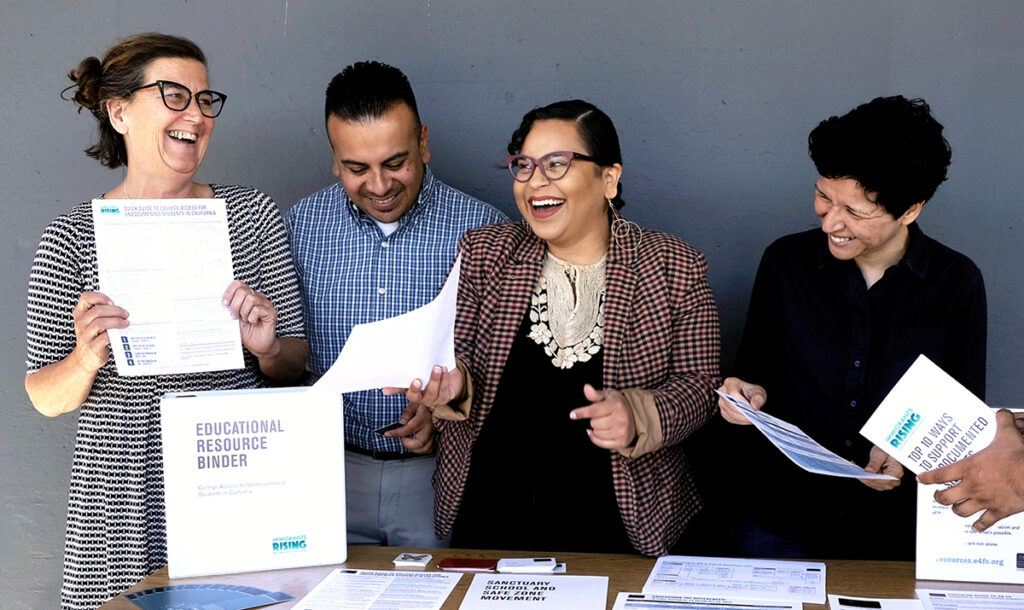
Immigrants Rising
Our team at Fíonta also understands the grantee perspective, offering our technology services to grant-seeking organizations like Immigrants Rising.
Transitioning from a fiscally sponsored organization to a full 501(c)(3) organization, Immigrants Rising needed help setting up the technology systems and processes that its fiscal sponsor had previously managed. Specifically, they needed help with grant tracking, reporting, and pipeline development.
Fíonta got to work and helped Immigrants Rising by:
- Configuring grants management in Salesforce to establish custom processes that support the full grant lifecycle.
- Creating dashboards that allowed Immigrants Rising to track current deliverables, assigned tasks, and upcoming deadlines.
- Building tools to support the grant lifecycle, such as tracking of research, application, decision status, and installment-based payments.
With their new system, Immigrants Rising had access to clean data, visibility into the entire grant pipeline, and a centralized place to manage grant application processes.
5 Grantmaking Best Practices
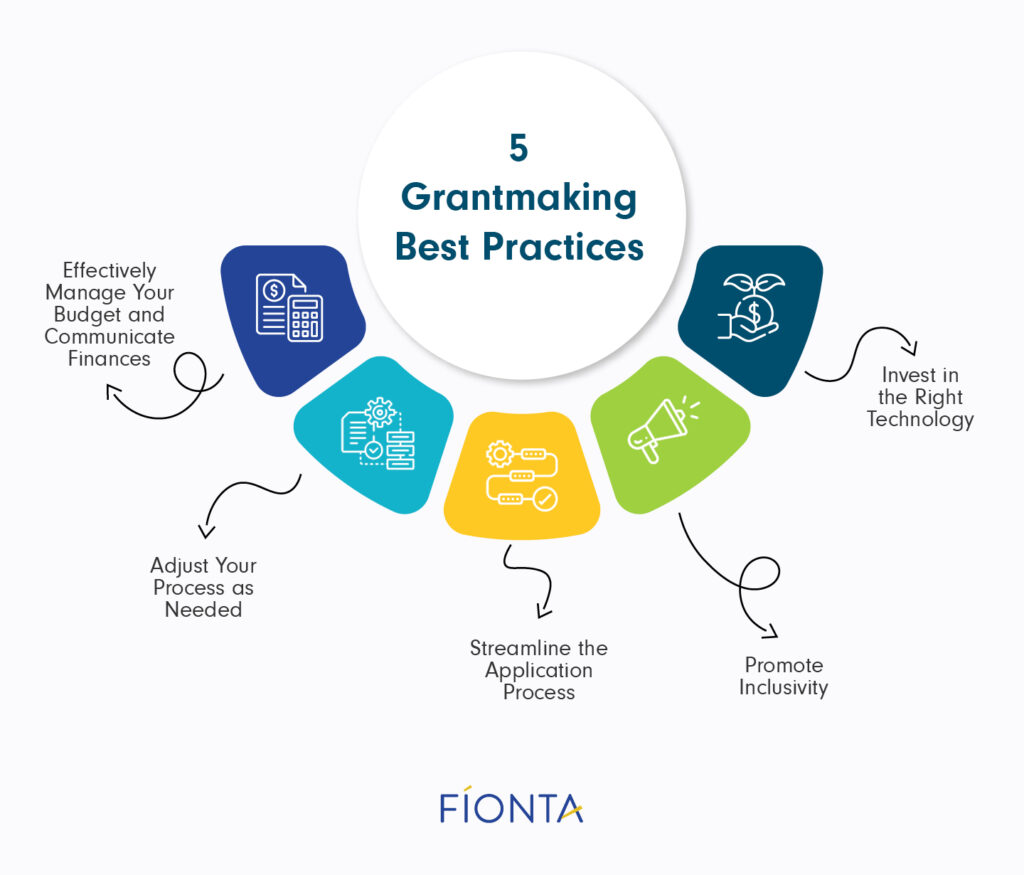
1. Effectively Manage Your Budget and Communicate Finances.
Managing your budget should be one of your foundation’s top priorities to ensure you meet your charitable impact objectives. A financial consultant will help you determine how much funding to give away through grants, when funding will be disbursed, and how to manage funding to continue operating sustainably.
In addition to funds allocated to grants, consider how much you expect your foundation to spend on employee salaries, promotion and marketing costs, software licenses, and other overhead expenses. Remember that your budget is not a contract but a general guideline. If you need to deviate significantly from your plan, consider the change and work to reshape the rest of your budget moving forward.
Your foundation must also maintain financial transparency to cultivate trust with grantees and the general public. Nonprofits often search for grant opportunities by reviewing foundations’ past funding projects to determine if their organization is a good fit for a grant. By ensuring your public financial reports are accurate and up to date, you can help exemplary nonprofits find your foundation more easily.
Finally, when setting your award amount for each grant, consider how much your foundation has available to allocate to each grant and how much is necessary to spend on a given project to make a tangible difference. While some projects may make significant progress with just $1,000, others may require $10,000 or more to be worthwhile.
2. Adjust Your Process as Needed.
You need an efficient, organized process for grantees to submit their applications, for your team to review them, and for funding to be used correctly. Regularly review your process to ensure each step is as streamlined and straightforward as possible, especially as your foundation grows.
Work with your decision-makers to identify opportunities for improvement by considering:
- Responsive versus strategic grants. Responsive grants are created to respond to specific community needs, a popular approach for new foundations. For example, a foundation might create grants for relief or rebuilding efforts after a hurricane. By contrast, established foundations often prefer strategic grants, which create grants to achieve a specific, long-term purpose.
- Review process. Ensure you have an established system for comparing various applications to promote objective scoring and decision-making. Specifically, many foundations use rubrics or rating systems to evaluate each application equally and maintain consistent scoring. Include reviewers from various backgrounds to include a wide range of perspectives.
- Outreach approach. How do you attract grant applicants? Leverage connections with nonprofits in your field by contacting members of their leadership team to discuss your grant and extend an invitation to apply. Create a dedicated page on your website for your grant that provides information on its purpose, how to apply, and who to contact with questions.
Take this time to determine who should own various parts of your grant process if you haven’t already. For instance, who communicates with applicants? Oversees distribution of funds? Manages follow-up processes? Delegating these tasks ensures nothing falls through the cracks. Work with your board and other key stakeholders to assign responsibilities based on each team member’s expertise, strengths, and availability.
3. Streamline the Application Process.
Keep in mind that your applicants are busy nonprofits in need of funding. Long application processes can place a heavy burden on these organizations, requiring significant time and resources to complete. Reducing the complexity of your application process and reporting requirements will boost their satisfaction and make it easier for your staff to review and score applications.
Automating repetitive tasks can save time and reduce errors caused by manual data entry. Revisit your application forms, ensuring they are standardized and straightforward, and request only necessary information. Clearly communicate what you need from applicants to reduce confusion and secure quality responses.
4. Promote Inclusivity.
Grantmakers must make concerted efforts to promote inclusivity when awarding grants, ensuring all eligible, interested applicants have a fair chance at receiving funds. Implement equitable grantmaking practices like:
- Providing support and additional guidance to smaller, less experienced organizations.
- Lowering or eliminating barriers to entry—for example, don’t rule out organizations based on factors like budget size alone.
- Clearly communicating guidelines in an accessible location and format. Ideally, you should be able to condense these guidelines into short information sheets that applicants can reference throughout the process.
- Simplifying requirements to reduce the burden placed on applicants. Keep requirements you truly need to monitor impact, but question those that exist as a standard or established practice.
Strive to listen to your grantees’ thoughts, concerns, and feedback. Adapt your processes to address any constructive comments you receive, and aim to create a simplified, low-stress application process.
5. Invest in the Right Technology.
Grant management tools provide a framework for your organization and ensure each step in your grant process is completed correctly and on time.
When reviewing grant management tools, look for solutions with the following features:
- AI capabilities. Boost efficiency, automate repetitive tasks, enhance communications, and more with AI-powered tools. AI streamlines the review process by summarizing applications or providing overviews. Predictive analytics help your organization forecast program outcomes and allocate resources to maximize their impact. We’ll discuss AI-powered grantmaking tools later in the guide.
- Communication tools. Maintain strong communication with your internal team and external applicants. Look for a grants management platform that allows you to track relationships with grantees and monitor their progress. Your solution should also provide a framework for internal review and communication to ensure your team stays on the same page throughout the review process.
- Application creation and management. Design a clean, functional application for grantseekers and ensure you have tools in place to receive, assess, and track applications. These tools should also enable you to continue monitoring your relationship with grant recipients and review the impact they made with the awarded funds.
- Reporting and tracking. Monitor your grant rewards to assess your foundation’s progress in fulfilling its mission. Determine when grant payments will be made, whether grantees have stayed adequately in touch following their awards, and what has been achieved with your grants.
While several grants management platforms are available, Salesforce Nonprofit Cloud for Grantmaking stands out for its comprehensive functionality, customization options, and intuitive features that foundations need.
How to Streamline Grantmaking Using Salesforce
Nonprofit Cloud (NPC) for Grantmaking is an NPC model designed to streamline the grant management process for both grantmaking organizations and grantseekers. As a part of NPC, it is built on the Salesforce platform and can be used with other Salesforce products and Industry Clouds.
Nonprofit Cloud for Grantmaking allows foundations to:
- Reliably achieve desired outcomes: Define goals or intended outcomes, indicate the specific strategies your organization will use to reach them, and identify success metrics.
- Track and manage relationships: See which people and organizations are involved with specific grants and applications, allowing you to oversee the entire grant lifecycle from a centralized source.
- Generate accurate, up-to-date reports: Manage your finances by tracking each grant’s stage and scheduling payouts.
- Create reliable, custom applications: Build dynamic forms tailored to your program’s unique requirements.
- Manage internal review processes: Keep your review process organized by allowing your reviewers to easily access and score applications, and boost efficiency with AI.
- Provide positive experiences: Use this solution with Experience Cloud to create branded portals that encourage collaboration and consolidate all grantmaking tasks into a single platform. Grantseeker and grantee portals allow users to view and apply for funding opportunities, upload documents, and submit follow-up impact reports for grants they have received.
Grantmaking With AI Tools
Salesforce also offers AI grantmaking capabilities supported by Einstein, which was renamed Salesforce AI in October 2025. With these tools, foundations can streamline approval processes and speed up fund disbursement with:
- Summaries of records about grantseekers and grantees, including application data, notes from meetings, etc.
- Summaries of awarded funding, including the award requirements, how the grant is performing, disbursement details, etc.
- Automatically generated, board-ready overviews of grant applications that streamline board review and other approval processes.
Implementing or customizing a grantmaking solution to fit your foundation’s unique needs can be a complex, technical process. Fíonta brings years of experience in both Salesforce and nonprofit grant management and is well-equipped to help you design and leverage a solution that serves your organization. Get started today to drive efficiency and outcomes, directing more funding to the causes and beneficiaries serving your mission.
How does Fíonta support grantmaking foundations?
Fíonta has extensive experience helping both grantmakers and grant-seekers improve their technology to better facilitate the grant process.
Here are a few examples of our work:
International Sustainable Energy Foundation (ISEF)
ISEF came to Fíonta looking for a way to simplify their platform’s processes for tracking grant applications, awards, and disbursements. The organization was already using Salesforce Grants Management, but they needed an expert partner who could customize their solution to simplify both grant management and fundraising.
Through our collaboration with the ISEF team, we developed:
- Automatic award letters that could generate accurate information about grants, budgets, and disbursements.
- Dashboards that enable ISEF’s staff to get an overview of their fundraising and grantmaking activities at a glance.
- A grantee portal that allowed ISEF to offer online application submissions, share grant statuses, submit quarterly reports, and send automatic deadline reminders to grantees.
With their new custom software solutions, ISEF was able to gain a deeper understanding of their grantees and support them during the application process.
Melanoma Research Alliance
Melanoma Research Alliance (MRA) needed to make its portfolio of available research funds more accessible on its website. Fíonta stepped in to replace their outdated grants display with a real-time Salesforce integration.
Specifically, our team:
- Built a live Salesforce connection, allowing newly awarded and updated grants to appear immediately on MRA’s website.
- Updated the existing Salesforce component to match MRA’s Webflow platform’s design system, creating a unified visual experience.
- Created front-end filtering and export options to help grant-seekers organize grants by type, year, institution, country, strategy, investigator, and keyword.
With the updated website, Fíonta enabled MRA to deliver accurate, filterable, and visually consistent grant opportunities, allowing all site visitors to easily explore MRA’s grantmaking activities.
Immigrants Rising
Our team at Fíonta also understands the grantee perspective, offering our technology services to grant-seeking organizations like Immigrants Rising.
Transitioning from a fiscally sponsored organization to a full 501(c)(3) organization, Immigrants Rising needed help setting up the technology systems and processes that its fiscal sponsor had previously managed. Specifically, they needed help with grant tracking, reporting, and pipeline development.

Fíonta got to work and helped Immigrants Rising by:
- Configuring grants management in Salesforce to establish custom processes that support the full grant lifecycle.
- Creating dashboards that allowed Immigrants Rising to track current deliverables, assigned tasks, and upcoming deadlines.
- Building tools to support the grant lifecycle, such as tracking of research, application, decision status, and installment-based payments.
With their new system, Immigrants Rising had access to clean data, visibility into the entire grant pipeline, and a centralized place to manage grant application processes.
Wrapping Up
Grantmaking allows your foundation to make a difference by empowering nonprofits to champion your mission through their work. As one of the top grant management tool providers, Salesforce Nonprofit Cloud has a diverse range of tools that can help your foundation oversee day-to-day operations. To learn more about how NPC can advance your grantmaking process and other parts of your foundation, reach out to our team at Fíonta.
Discover more resources about Salesforce and grantmaking:
- How to Get Started and Grow With Salesforce for Nonprofits. Explore all that Salesforce has to offer nonprofits, including grantmaking organizations.
- Navigating the Transition from FoundationConnect to Nonprofit Cloud. Learn about the implications of the foundationConnect winddown and what to consider when migrating to Nonprofit Cloud.
- Why Grants Management is Key for Nonprofit Accounting. See why and how to track and manage grants from a grantee’s perspective.
Ready to start the grantmaking process? Find out how your foundation can implement Salesforce’s Grant Management. Contact us today!