

Raiser’s Edge vs Salesforce: 8 Reasons to Switch

Sometimes, you need to cut the cord and move on to more sophisticated tools. You’ve parted ways with your flip phone, junked your CDs in favor of streaming tunes, and dropped cable for streaming services.
While letting go of these old technologies wasn’t too difficult, moving on from a mission-critical system like your donor database is not as easy. Yet many in the nonprofit world seek a more secure, flexible, and future-forward alternative to Blackbaud Raiser’s Edge. In this guide, we’ll explore some reasons why it might be time for you to make the switch:
- Raiser’s Edge and Salesforce Nonprofit Cloud Basics
- 8 Reasons to Switch to Salesforce
- How to Choose Between Raiser’s Edge and Salesforce
Let’s kick things off by comparing the two systems to examine the key differences between them.
Raiser’s Edge and Salesforce Nonprofit Cloud Basics
Raiser’s Edge and Salesforce Nonprofit Cloud are both CRM solutions designed to help organizations better manage their data and bolster stakeholder engagement.
As your organization grows, Nonprofit Cloud can become a more suitable option due to its high customization, functionality, and security level. As a product built by nonprofits for nonprofits, Salesforce’s Nonprofit Cloud has many exceptional benefits.
Raiser’s Edge vs Salesforce Nonprofit Cloud
Raiser’s Edge and Salesforce Nonprofit Cloud do share some qualities. Both of these solutions are:
- Cloud-based platforms
- Centralized databases
- Designed to help nonprofits manage donor relationships, track fundraising campaigns, process donations, and keep operations running smoothly
- Able to analyze and report on organizational data
While similar in functionality, they do have several differences, and to make the best choice for your organization, you must analyze these variations closely. These fall into three main categories, including:
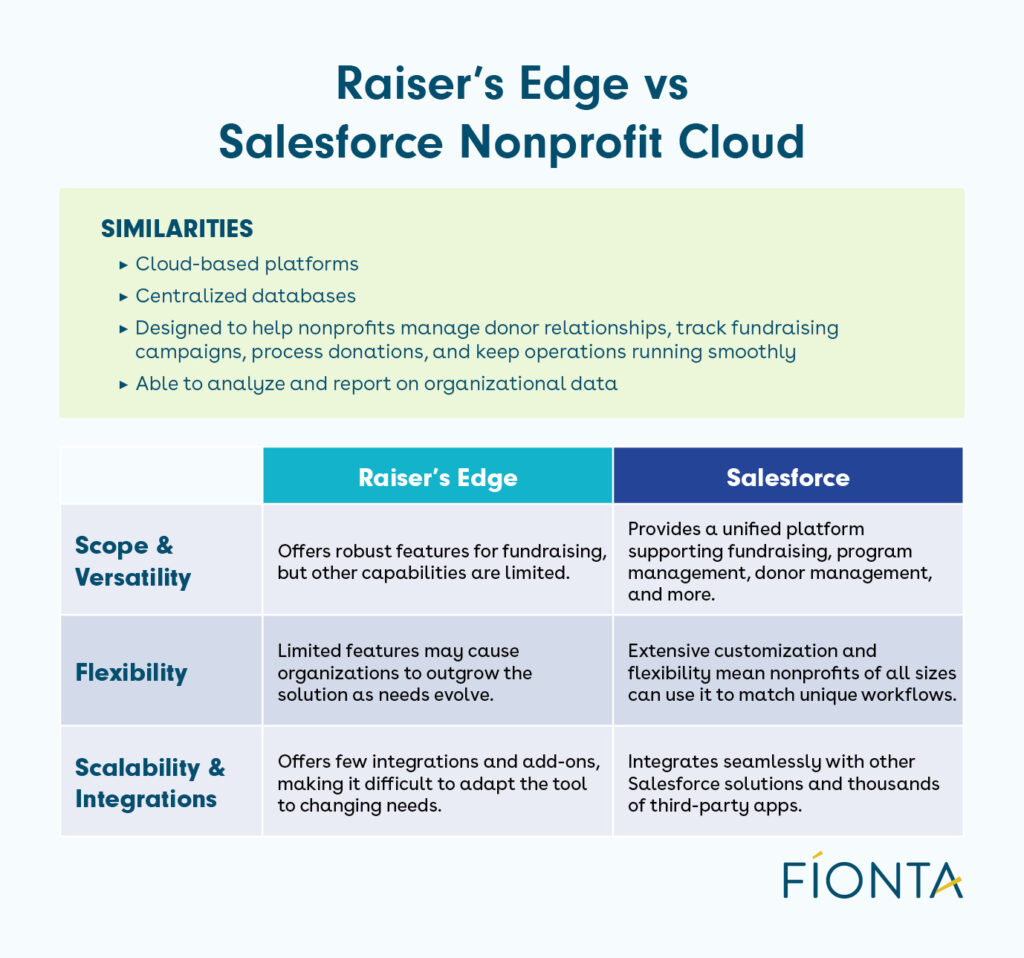
- Scope and versatility: As a fundraising CRM, Raiser’s Edge offers robust fundraising-focused features. However, its features beyond fundraising are limited. Choose Nonprofit Cloud to access tools that support fundraisers, program management, donor management, and more.
- Flexibility: Salesforce offers extensive customization and flexibility, allowing nonprofits of all sizes to utilize it effectively. Because Raiser’s Edge has limited features and scalability, organizations may outgrow the solution.
- Scalability and integrations: Raiser’s Edge offers limited integrations and add-ons, making it difficult for nonprofits to adapt the tool to suit changing needs. Nonprofit Cloud, on the other hand, integrates seamlessly with other Salesforce solutions and apps.
8 Reasons to Switch to Salesforce
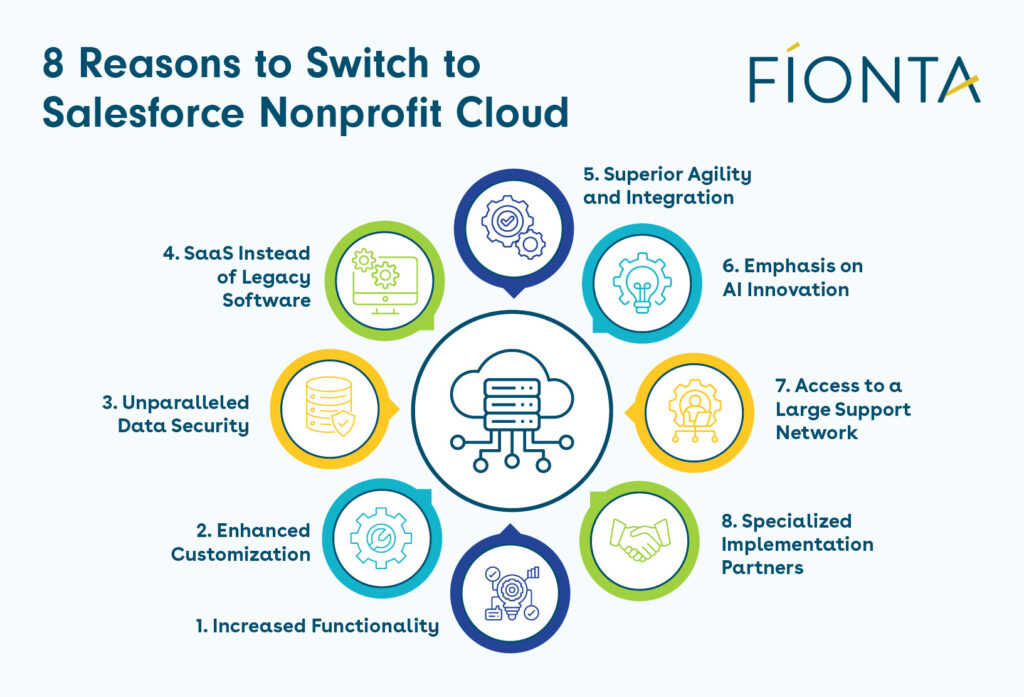
1. Increased Functionality
Nonprofit Cloud provides mission-critical support for fundraising, grants management, donor management, volunteer management, member management, and case/program management.
Salesforce is more than just a CRM. It provides a single source of truth and a 360-degree view of interactions with your members, volunteers, donors, and other stakeholders. Additionally, it provides the analysis and reporting power necessary to gain insight from those interactions.
With Nonprofit Cloud, you can attract new donors, nurture those relationships, engage stakeholders, build loyalty, and drive more revenue. Its built-in AI analytical tools and reports help you understand stakeholder behavior and predict outcomes to make data-backed decisions faster. This increased functionality makes a huge difference and sets Salesforce apart when comparing it to Raiser’s Edge.
2. Enhanced Customizability
Salesforce for Nonprofits is designed to be versatile and accommodate a wide range of nonprofit organizations. Nonprofit Cloud offers extensive customization options so nonprofits can evolve their system to meet changing needs. As an example, your nonprofit may need to implement a more robust volunteer management system as its volunteer program grows.
Nonprofit Cloud’s customizability surpasses that of Raiser’s Edge in a variety of ways, including:
- Platform architecture: Nonprofit Cloud is built directly on the Salesforce platform, allowing users to access other Salesforce tools such as Common Components and Industry Clouds. Raiser’s Edge operates within a more rigid architecture, limiting customization opportunities.
- AppExchange ecosystem: The Salesforce AppExchange is a marketplace of applications and integrations from third-party vendors that extend the platform’s functionality. Choose from thousands of options to enhance your nonprofit’s capabilities.
- Custom objects and fields: Nonprofit Cloud enables users to create custom objects and fields to track data specific to their organization. This supports unique data needs, enhancing data collection and accuracy. A nonprofit could set up a custom object for managing volunteer opportunities and add custom fields, including the volunteer spot’s name, location, and date.
Nonprofit Cloud also offers customizable workflow automation capabilities through tools like Salesforce Flow. Organizations can set up custom workflows to automate repetitive tasks, such as donation processing and program delivery. Its advanced, flexible capabilities outshine those of Raiser’s Edge.
3. Unparalleled Data Security
In 2020, the Blackbaud-hosted Raiser’s Edge platform suffered a data breach. Since the breach, the FTC filed a complaint against the company in response to lax security practices. In response to the data breach, however, Raiser’s Edge clients, who had once been steadfast in resisting the move to more robust CRM solutions, started seeking alternatives.
Salesforce prioritizes and protects the privacy of its users and their customers. It leverages extensive data security measures, including:
- Strengthened passwords and multi-factor authentication: Hackers often gain access by guessing weak administrative passwords. This vulnerability is not an issue with Salesforce because each user is provided a unique, strong username and password. The platform also requires multi-factor authentication, which requires a secondary verification method (such as a code sent to your email) and reduces the risk of a material breach by 50%.
- Advanced security settings. With the security settings in Salesforce, you control access to data on a granular level. For example, you can set permissions for specific people to access certain data types. Additionally, you can limit their actions to viewing data or allow them to edit files depending on their role.
- No unnecessary storage of sensitive data. Salesforce.com doesn’t use cookies to store confidential user and session information. Instead, it implements more advanced security methods based on dynamic data and encoded session IDs. Your organization’s data is protected in the Salesforce Cloud by secure socket layer (SSL) technology using server authentication and data encryption.
Salesforce believes security is impossible without transparency. Salesforce clients can access real-time information about their system performance and security. Top security professionals review the software’s code for potential security risks before it’s made available to clients, and every Salesforce release includes information about the latest security enhancements.
When comparing Raiser’s Edge vs Salesforce, Salesforce excels in data security.
4. SaaS Instead of Legacy Software
Raiser’s Edge has been around for more than 30 years and was initially developed as on-premise software. Even the newest software version, RE NXT, requires clients to host their database on a VPN like Citrix to access the software remotely and toggle between the web interface and the legacy software. This inconvenient process creates lags when viewing updated information.
Salesforce, on the other hand, is cloud-based and runs on a multi-tenant architecture. This means every Salesforce customer uses a regularly updated version of Salesforce software in the cloud. Your nonprofit enjoys the same level of performance and security as Salesforce’s biggest clients, like Amazon Web Services and Spotify. However, you can configure Salesforce to meet your organization’s specific needs—one of the benefits of Software as a Service (SaaS).
Another benefit of SaaS is regular updates for all users. Nonprofit Cloud receives three major releases per year, along with monthly updates, many of which include enhanced security measures. Unfortunately, updates aren’t nearly as frequent for the nonprofit users of Raiser’s Edge.
5. Superior Agility and Integration
Legacy software users often have to adapt their business processes to the software’s limitations. Raiser’s Edge clients have limited integration options with the software’s API. Integrating Raiser’s Edge with other Blackbaud products is challenging, let alone with other third-party software. This is an unsustainable approach to technology.
The nonprofit world constantly changes, and you need tools that can adapt to changing development, marketing, and communication strategies. With Salesforce’s AppExchange and open API, you have many integration options for achieving a 360-degree view of stakeholders. Instead of adapting to fit your software’s limited capabilities, choose a solution like Salesforce to accommodate your organization’s needs with relevant and optimized functionalities.
6. Emphasis on AI Innovation
Many tech companies are looking for ways to incorporate AI into their offerings, and Salesforce is no exception. Einstein, recently renamed Salesforce AI, is an AI technology built into Salesforce designed to help users automate repetitive tasks, personalize communications, and make informed decisions based on predictive analytics. For instance, nonprofits might use this tool to forecast trends or score a donor’s likelihood of upgrading.
Salesforce also offers Agentforce for nonprofits, a product that allows users to build and deploy custom autonomous AI agents. These agents can perform tasks independently, making them much more advanced and capable than traditional AI chatbots. Rather than following a script, these agents can reason, reference data, and execute actions (e.g., answering complex donor questions, scheduling a volunteer shift, etc.).
While Blackbaud also offers AI-powered tools, they tend to be more focused on fundraising and development, helping nonprofits identify major donor prospects and analyze their fundraising data. Salesforce agents have a much broader set of use cases, are more customizable, and are designed to be highly autonomous.
7. Access to a Large Support Network
According to Salesforce, the company has over 76,000 employees and more than 200,000 certified experts. With such a large network at your fingertips, it can be easier and more cost-effective to find Salesforce support compared to more niche solutions.
Additionally, Salesforce has a robust Trailblazer Community of more than 20 million innovators where users can learn skills and connect with other Salesforce users. This community, in conjunction with Salesforce training resources, helps nonprofits learn more about using their CRM, maximizing efficiency, and improving fundraising results.
8. Specialized Implementation Partners
Another advantage of the Salesforce community is the highly skilled and knowledgeable implementation partners. For example, Fíonta specializes in customizing and integrating Salesforce for nonprofits and associations. This opens the door to enhanced functionality and convenience you can’t access with Raiser’s Edge.
To learn more about what we do for our clients at Fíonta, schedule a call with us today!
How to Choose Between Raiser’s Edge and Salesforce
While there are many compelling reasons to consider switching to Salesforce, making the right final decision depends on your organization’s needs and goals. Here are a few key considerations if you feel overwhelmed by the decision:
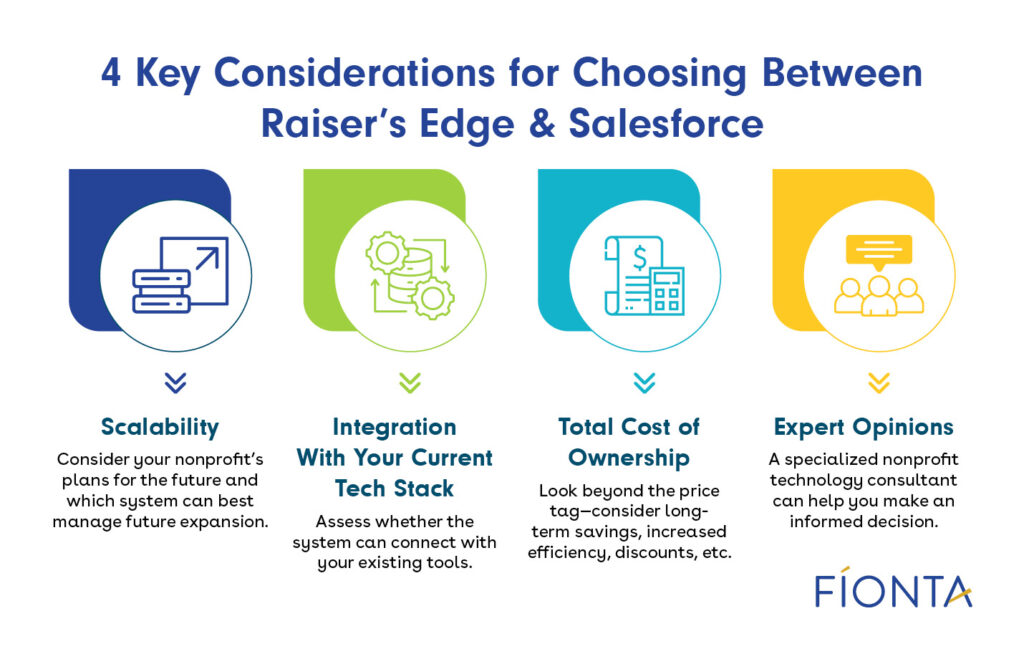
- Scalability: Consider your nonprofit’s plans for the future and whether your system can handle future expansion. Because Salesforce is cloud-based, focuses on innovation, and delivers frequent updates, it will scale alongside you without the need for costly upgrades.
- Integration with your current tech stack: Assess whether the system can connect with your existing tools. The Salesforce AppExchange offers thousands of pre-built integrations that connect these tools to your Salesforce instance, ensuring a unified data source across all your applications. This method tends to be simpler and more cost-effective than the options offered by other vendors.
- Total cost of ownership: Cost will likely play a significant role in your decision, but remember to consider the broader implications beyond the initial price tag. For example, due to its extensive flexibility and customization options, Salesforce can achieve lower long-term costs by reducing the need for expensive custom development or migrations to new tools. Additionally, its Power of Us program provides discounts for nonprofits.
- Expert opinions. A specialized nonprofit technology consultant can audit your nonprofit’s unique needs across all departments, from fundraising to programming. These experts also possess the deep technical expertise necessary to tailor Salesforce to meet your specific needs and support future growth.
Raiser’s Edge vs Salesforce: Final Thoughts
Don’t let dated software hold your organization back. You need software like Salesforce that allows you to innovate and shift gears in response to crises, changing economic conditions, and emerging stakeholder and member needs.
To learn more about using Salesforce to enhance your nonprofit’s operations, fundraisers, and relationships with donors, explore these additional resources:
- How to Get Started and Grow With Salesforce for Nonprofits. Need to learn more about Salesforce before making a final decision? Explore this comprehensive guide.
- A Guide to Understanding Salesforce Nonprofit Cloud. Dive into the basics of Nonprofit Cloud and how your organization can use it to optimize fundraising, programs, case management, and more.
- How to Select a Salesforce Partner for Your Organization. Implementing your Salesforce CRM or looking for long-term support to help you get the most out of it? Learn how to choose a Salesforce partner in this guide.
Make an investment in secure, flexible, and future-forward software like Salesforce Nonprofit Cloud. Contact us to learn how Fíonta can help you move to Salesforce.